2026.05.09
Rick Mills, Editor/ Publisher, Ahead of the Herd:
Please give us a summary of Orestone’s Francesca Project and then we will get into the latest release.
David Hottman, Chairman & CEO, Orestone Mining (TSXV:ORS):
The Francisca Project was acquired in February of 2025 and it’s a project that offers a unique opportunity in the gold space in that it is exposed to surface akin to what an open-pit deposit would be.
It appears that it might be heap-leachable, which is the least capital intensive and arguably one of the best returns in the gold mining business. Since acquisition, we have continued to de-risk the project with a series of mapping and sampling programs that have refined the target, which will be drill-tested in the coming months.
The goal of the mapping, sampling and then the ultimate drill program is to test the exposures of gold-silver mineralization over a length of up to 1,100 meters.
The concept is that testing the large IP anomaly that lies underneath it could yield results that would indicate the potential for a multi-million ounce gold project. In the meantime, what we see exposed at surface, all of the work that we’re doing there continues to de-risk the project towards an orebody that may be mineable, as I mentioned, open pit and heap leach. So basically, everything that we’re doing is a methodical step by step de-risking of the project.
RM: Leading up to the first ever drill program?
DH: Yes. The exploration results that we released yesterday don’t necessarily identify a large or a high-grade orebody. What they do demonstrate, because we were cleaning out previously excavated trenches and resampling them, is low cost or very cost-effective exploration.
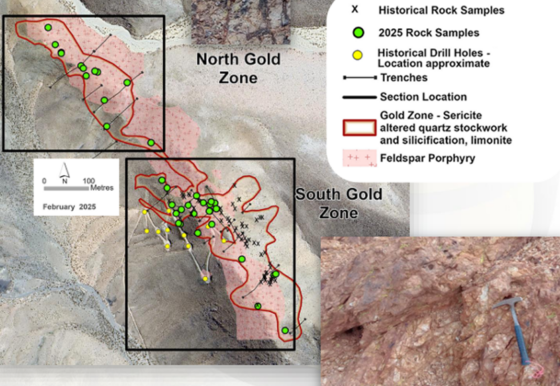
We did not go and do a trenching program that trenched completely across the zone, say every 100 meters over that 1,100-meter length. We went and cleaned out previously excavated trenches and resampled them so that we have our own data. We had historical data in summary form in reports from 25 years ago, but even though they were good people by reputation that conducted the exploration and reported those results, without the granular detail, we need to go out and redo that exploration.
So, fast forward, what is the most significant thing about the May 7th press release? That it is a significantly juiced up or mineralized system. That’s all that those grades show. Ultimately, we need to have long intercepts or consistent intercepts of mineralization in drill holes.
We’re hoping that we’re going to see something take shape that is plus or minus one gram per tonne gold with, who knows, a half an ounce of silver, quarter of an ounce of silver, that type of scenario. So, that’s all that the release should be used for, so to speak, is as proof that the system is really juiced up. Very exciting numbers in terms of the grades.
One of the things that wasn’t adequately described in the press release, or that needs a little bit more color, is that in both trenches, but specifically trench 7, we had two intervals of mineralization separated by a low-grade interval. Because Gary Nordin is an economic geologist that has been involved in development of a lot of resources into mines and whatnot, we treat the reporting very conservatively. At $4,000 to $5,000 gold, some of that low-grade may very well be above the cutoff grade.
But trying to smear the grade across, you have to look at the results and say, okay, irrespective of economics, the grade really drops off, so it’s a separate intercept here to the left and to the right. Those are the takeaways. It’s a good-size zone at surface, even though it doesn’t indicate multi-million ounces there’s some nice mineralization in several different pods that we see at this point. It’s quite exciting.
RM: If you were using a baseball analogy, where would we be in regard to this news?
DH: If we’re playing baseball the pitcher has just pitched, it’s a slow ball, and Babe Ruth is up to bat.
RM: I like that.
DH: The results are a home run in the sense that it’s really a juiced-up system. It’s very exciting. I should be jumping up and down, but one trench does not a mine make.
RM: Mines are built one step at a time.
DH: That’s right. Sample results are coming in all the time. We took just about 700 samples and we’ve probably received a third of them back. The balance of the results are coming in and I would hope that by next week or the Monday following we would have all of the results and be able to announce them.
If they track based on what we’ve seen so far, we’re going to have mineralization in most of the areas where we expect mineralization and no mineralization where we don’t expect mineralization. It’s a confirmation sampling program, which will guide the upcoming drill program.
RM: Did we do new trenches or did we clean and sample the old ones?
DH: We did some new excavation and/or cleaning up of areas that we then sampled, but we did not do methodical grid-based excavation of trenches. Regarding the cleaning out of old trenches, as long as the old trench got down to bedrock, and your sampling bedrock, it’s good.
And so, we now have representative samples of the rock, and that’s good enough quality to go to the next phase which is drilling.
RM: Okay. Now, I put up three what I thought were very instructive heap-leach gold and silver projects. I’m going to post them for entertainment/ education advice only. They are not to be used for investment consideration into ORS.
Orla Mining Feasibility Study Feb. 2026, South Railroad Project
Revival Gold March 31st, 2025, Preliminary Economic Assessment, Mercur Gold Project
i-80 GOLD February 21, 2025, Preliminary Mineral Assessment, Mineral Point Project
DH: Very interesting, those are large undeveloped resources that in this gold price environment could make really profitable mines, you’ve got to realize that they’re going for scale. Are they going to be 100,000, 200,000 or 300,000 ounce a year operations?
At this point in Argentina, we don’t know if we have a mine or what we ultimately see as the size of the orebody; would it be suitable for 20,000 ounces-a-year operation or 200,000 ounces-a year operation. We’re a ways away from that and there area few more steps that have to be successful
All we’re saying right now is that what we see at surface now is pretty exciting, a possible open-pit project.
RM: What else are you doing now to advance the project?
DH: We’re already looking at surface rights. Where are we going to find water? We’ve pulled samples for metallurgical testing out of the surface trenching. They’ll be 24-hour bottle roll tests completed soon.
Once we drill, we will both excavate sample material for column metallurgical tests, as well as use the chips or rejects from the RC drilling for column tests. We know from some historical work that the gold does come out we just need to start defining this as we go forward.
Some of the next things that will be released to the public going forward, call it within the next 60 days will be, more assay results, potentially acquisition of historically taken IP surveys, acquisitions of land, metallurgical reporting, and initiation of a drill program.
RM: Do we have the treasury to accomplish all the way through to the end of the drill program?
DH: Yes, we’ve got enough that we could do two phases of drilling at the level that we’re looking at, which is 1,200 meters on the initial program.
Once we get to drilling and the assays come back, we can pull the trigger and just keep going. I’m sure the money will follow, but we’ve got enough to carry a couple of drill programs.
RM: Well, it’s damn nice to see a management team so concerned with dilution. I’m getting tired of all these blown-out share structures talking like they own the world, and they’ve got 400 million shares outstanding. I think it’s getting a little ridiculous.
DH: Well, saying they own the world. No, the world owns them, because are enough shares out for a measurable percentage of people in the world to own some.
RM: True enough.
DH: I’ve been involved in numerous successes and some takeovers. I’d like to see my shares go to $10 not to $0.50. It’s a question of whether I’d want to own 100 million shares at $0.50, or 5 million shares at $10. There is a difference.
RM: There is, and people need to realize that if you want to build something and potentially sell it, you make more money the lower the share count. It’s that simple.
DH: Structure is important.
RM: Yes, would you rather divide $500 million by 400 million shares or 100 million shares? But it’s nice to see teams on AOTH like Orestone and all the others that are concerned about that kind of thing.
DH: Yes, we are. And that’s why we didn’t go out and do the grid excavation of new trenches. There’s a lot of trenching that’s been done in the past. It’s already been paid for by somebody else. Let’s just clean it out, resample it. We save a lot of money.
The investor or the analyst out there would like to see the grid type of trenching. But that’s not going to tell you what you have. You have to drill it. So, what we did saved a lot of money, plus gave us the confidence from the information we received and now we’re ready to move forward.
RM: The way you’re talking, it sounds like, if the project has the legs to run down the development path to being a mine, you and the team would not be adverse to going mining.
DH: We’re not afraid of that, we’d like to do it. We’ve all been down that road numerous times in our careers.
RM: I wrote something the other day in prep for this talk, “this is a program from experienced, knowledgeable veterans in the industry who have discovered and built heap leach mines. Bottom line, they know what they’re doing.”
DH: Well, there is one caveat to my answer Rick, and that is, if it turns out to be a 5 or 10-million ounce porphyry, and the mine is going to take five or 10 years to do all of the engineering and the financing, and it’s going to be a half-million-ounce-a-year producer at a cost of $1 billion, I don’t think we’re necessarily up for that. That takes a toll on one’s life.
It’s like if you were asked to commit to building a media empire, at your age, it doesn’t mean that you can’t do it. The question is, do you want to?
RM: No, but if it was a much smaller scale it would be a lot easier to consider doing.
DH: Yeah exactly, and I’d say up to a couple million ounces, and we’d look at a 10-year mine life because the market doesn’t give any value after 10 years. A lot of times, depending on the size of the deposit, you might make it an eight-year life. You usually find more ounces here and there, satellite deposits, going a little bit deeper once everything’s paid for.
It just depends on size.
RM: Okay, thank you for your time.
DH: Thanks Rick.
Richard (Rick) Mills
aheadoftheherd.com
Subscribe to AOTH’s free newsletter
Richard owns shares of Orestone Mining (TSXV:ORS). ORS is a paid advertiser on his site aheadoftheherd.com This article is issued on behalf of ORS